
MISSING COMPLETE UPPER TEETH

Complete Teeth Replacement with Dental Implants in the UPPER JAW
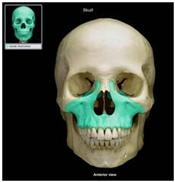
Upper jaw is called MAXILLA.
The available bone in the upper jaw for placement of implants is below the nose cavity and maxillary sinuses. When compared to the lower jaw, the upper jaw bone is very soft and more time is taken for the implants to get united to the bone. Placement of implants is more demanding in upper jaw as it is the upper teeth which are more visible during smiling. So the assessment of upper lip length and smile line is very important and that will decide on the placement of implants. There are two large sinuses called maxillary sinuses are in the upper jaw on the either side of the nose.
In patients who lost upper teeth for long time, the upper jaw shrinks considerably then the placement of implants is possible only with bone grafting /augmentations.
What Happens If The Complete Teeth Are Lost?
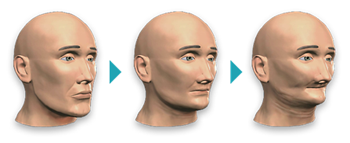
The part of the jaw bone holding the teeth starts shrinking and an old age look sets in . Impairment of chewing and speaking causes social and health problems. The only treatment that can prevent shrinking of bone is to place implants. The jaw bone recognizes the implant as the lost root of the teeth. The function imparted by the implants increases the density of the bone and the shape is maintained. So dental implant is done not only for cosmetic reasons but also for functional reasons.
Removable dentures aggravate the bone shrinking especially in the upper jaw.
Teeth Less Condition For A Long Time.
The jaw bone shrinks to such an extent that the placement of implants will be difficult. Additional surgical procedures will be needed for bone augmentations and to place the implants.
If the bone volume is less then bone augmentation procedures are needed to place the implants. This can be done safely by trained maxillofacial surgeons. So if you have been told that there is insufficient bone by any implant dentist, your next step will be to meet a maxillofacial surgeon trained in implant dentistry.
It is also noticed that some implant dentists who are not trained in placing implants in compromised jaw bone in the back of the mouth removes good front teeth to place implants so that the back teeth can be cantilevered from the front implants which is not a good practice.
IMPLANT SUPPORTED BRIDGE
To replace all the teeth in the upper jaw 6 implants are needed. The placement of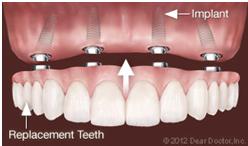 implants can be done in one surgery or a maximum in two days time. The time needed will be one hour each.
In three days time a temporary denture will be fabricated and given.
OVER DENTURE
Two to four implants can be used to stabiles the denture. With this treatment you still have to remove the denture. But this is cost effective treatment for stabilizing a very loose denture.
SINGLE AND TWO STAGE OVER DENTURE
Single piece implants with ball heads can be inserted to the jawbone and dentures can be immediately loaded. This is very quick and less expensive treatment to stabilize the denture. Since the implants are loaded immediately the success rate of such implants are less than a two stage treatment. In two stage treatment you leave the implants submerged in the bone for Osseo – integration to happen. With this treatment the success rate is as good as any two stage process. The advantage of this treatment is that at a later stage more implants are placed then this can be converted to complete non removable implant supported prosthesis.
SUCCESS
In the upper jaw dental implant treatment is very successful. 96% -98% successes is easily achieved. The healing period between the first and second stage is 4 to 6 months and implants loading time is more compared to the lower jaw.
TYPES OF ARTIFICIAL TEETH ATTACHED TO IMPLANTS.
The artificial teeth can be metal fused porcelain crowns which can be cemented on to the abutments or screw retained. In case of severely shrunken jaw and when the patient has facial changes hybrid dentures are the choice. This has the features of dentures and crowns.
In some cases dentures can be stabilized by implants as over dentures or bar retained dentures.
RESTORATION DURING HEALING PERIOD.
In normal maxilla implants can be loaded in four to six months time. When surgical techniques are used to augment the jaw bone by bone grafts etc more healing period is required and up to six to 8 months are needed.
TRANSITIONAL IMPLANTS
When complete replacement of upper teeth is done with dental implants, there is difficulty in stabilizing temporary denture. There are no existing teeth to which the denture can take support by way of clips or other accessories. The temporary denture can also exert pressure to the implants impairing the union of implants to the bone.
To help the situation transitional implants are used to support the temporary denture. These are very slender implants which are single piece unlike the conventional implants which are totally buried in the bone under the gum. The TRI will protrude thru the gum and has a ball head. The fitting surface of the denture will have nylon ring to snap fit into the transitional implant ball head. This mechanics give stability for the upper temporary denture.
The life of transitional implants is less than conventional implants are they are immediately loaded. By any chance if the TRI also get integrated then it will also be incorporated into the permanent teeth…
Two TRI are needed in each jaw making four TRI for the full mouth.
Implant treatment is 98% successful. An integrated implant is 8 times stronger than natural tooth and can last a life time.
BENEFITS OF IMPLANT SUPPORTED BRIDGE OR OVER DENTURE
- Maintains integrity of facial structure (prevents further bone deterioration)
- Increases comfort and stability
- Restores natural biting strength
- Improves health due to better eating habits and improved digestion
- Eliminates need for adhesives
- Improves appearance (lost lip support restored)
- Builds confidence in eating and speaking more clearly.

Book Appointment

Consultation

Dental Treatment

Payment



Mr.Grahambell is working for the Petroleum industry in Australia. He had his full mouth dental implants done in 2010.

A senior ICU nurse in Australia. A chief nurse of her caliber has very carefully scrutinized the sterilization standard at Scientific Dental Clinic and after being personally satisfied she decided to represent the clinic in Australia.